
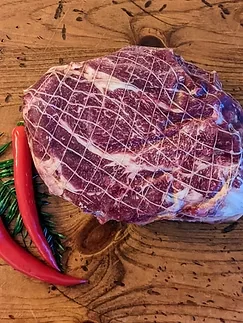
Blade Roast
Sunday, handled.
About this cut
A netted blade roast from the shoulder. Enough connective tissue to go rich and shreddable after a few hours in the oven.
How it works
- Frozen and vacuum-sealed for freshness.
- Farm pickup by appointment only in Norwich, or local delivery in Norwich and area.
Cooking tips
- 1Sear all sides, then add onions, stock and herbs to a covered oven-safe pot.
- 2Braise at 150°C / 300°F until fork-tender, often 3–4 hours or longer depending on size. Add liquid if the pot gets dry.
- 3Rest briefly in the braising liquid, then slice or shred. Remove any netting before serving.
Health Canada recommends at least 63°C / 145°F for beef steaks and roasts (medium-rare), 71°C / 160°F for medium, or 77°C / 170°F for well-done. Mechanically tenderized beef needs at least 63°C; turn steaks at least twice. Follow any higher temperature on the package.
Portion guidance
Allow 250–300 g of raw blade roast per adult for cooking loss. A 2 kg roast gives roughly 6–8 generous servings with sides.
Serve with the braising juices and potatoes; shredded leftovers work well in sandwiches.
Serving estimates are a guide, not a guaranteed pack weight or yield. Allow for appetites, sides and cooking loss.
Storage instructions
- Keep frozen at −18°C / 0°F or colder. Follow the package’s storage directions and dates.
- Thaw on a tray in the refrigerator at 4°C / 40°F or colder, never on the counter. Larger roasts may need several days. Keep raw juices away from other food.
- Once thawed in the fridge, cook within 2–4 days. For best freezer quality, use steaks and roasts within 10–12 months; continuously frozen beef remains safe longer, but quality declines.
- Refrigerate leftovers within 2 hours in shallow containers, use within 2–3 days, and reheat to 74°C / 165°F.
Food safety guidance: Health Canada cooking temperatures · Storage · Leftovers