
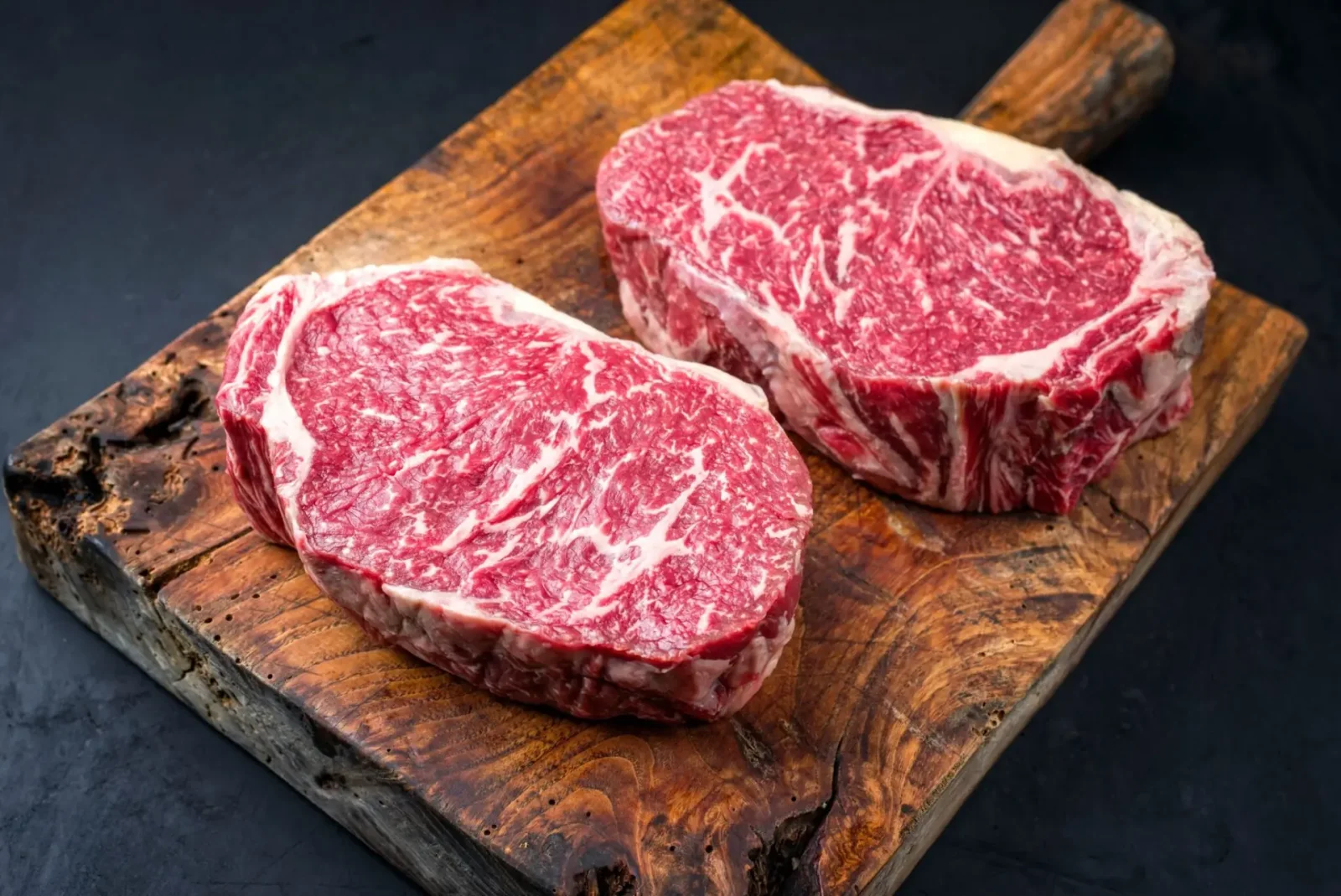
The marbling does the work.
Wagyu is a specific breed group with a specific kind of fat. Here's what that actually means at the table, and how we raise ours in Norwich.
What makes Wagyu different
"Wagyu" means Japanese cattle. What matters for eating is the fat: Wagyu develops fine flecks of fat inside the muscle, not just around it. That's marbling.
Wagyu fat melts at a lower temperature than typical beef fat. So when you cook a Wagyu steak, the fat starts rendering earlier and keeps the meat basted from the inside. That's why it tastes richer and stays tender.
You use less of it. A Wagyu steak feels satisfying at a smaller portion, and the leftovers are just as good the next day.
How we raise ours
A few questions we get asked most often.
Are these fullblood Wagyu or a cross?
Both. Our herd includes fullblood Wagyu and Wagyu-cross cattle. The fullbloods give us our deepest marbling, and the crosses carry that same fine fat through the rest of the lineup — all raised the same way on our own pasture.
What do the cattle eat?
Our cattle are raised on pasture here in Oxford County. They are grass-fed and corn-finished, and we carry them 32 to 36 months before harvest. Commodity beef is typically finished at 18 to 22 months. That extra year is not a marketing decision, it is the only way the intramuscular fat has time to lay down. Every animal is raised antibiotic and hormone free.
How long do you hang the beef?
Standard aging or hanging time for Wagyu beef typically ranges from 21 to 30 days for hanging/dry-aging, or 14 to 28 days.
Do you handle everything yourselves?
We raise every animal from birth on our farm. Butchering is done at Norwich Packers, a provincially inspected facility a few minutes down the road that we have worked with for years. It is cut, vacuum-sealed, and packed there, and it comes straight back to us.
How to cook it
Salt an hour ahead. Hot cast iron pan, one flip, butter-baste. Aim for 130°F internal for medium rare. Rest five minutes.
Salt just before cooking. Form loose patties, cook hot and fast, don't press down. Great for burgers, ragù, and meatballs.
Sear, then braise low and slow at 300°F with stock, onions, and aromatics for three to four hours. Skim fat before serving.
Wagyu from our farm vs. grocery store beef
| Question | Steenholl Wagyu | Grocery beef |
|---|---|---|
| Do you know the farm? | Yes, ours. Come visit. | Rarely. |
| How many farms went into it? | One. Ours. | Often many, pooled at the packer. |
| How fresh? | Butchered, portioned, and frozen at peak. | Depends on transit and shelf time. |
| Marbling grade | Wagyu-level intramuscular fat. | Commodity grades vary. |
| Who to ask questions? | Us, directly. | Store clerk. |